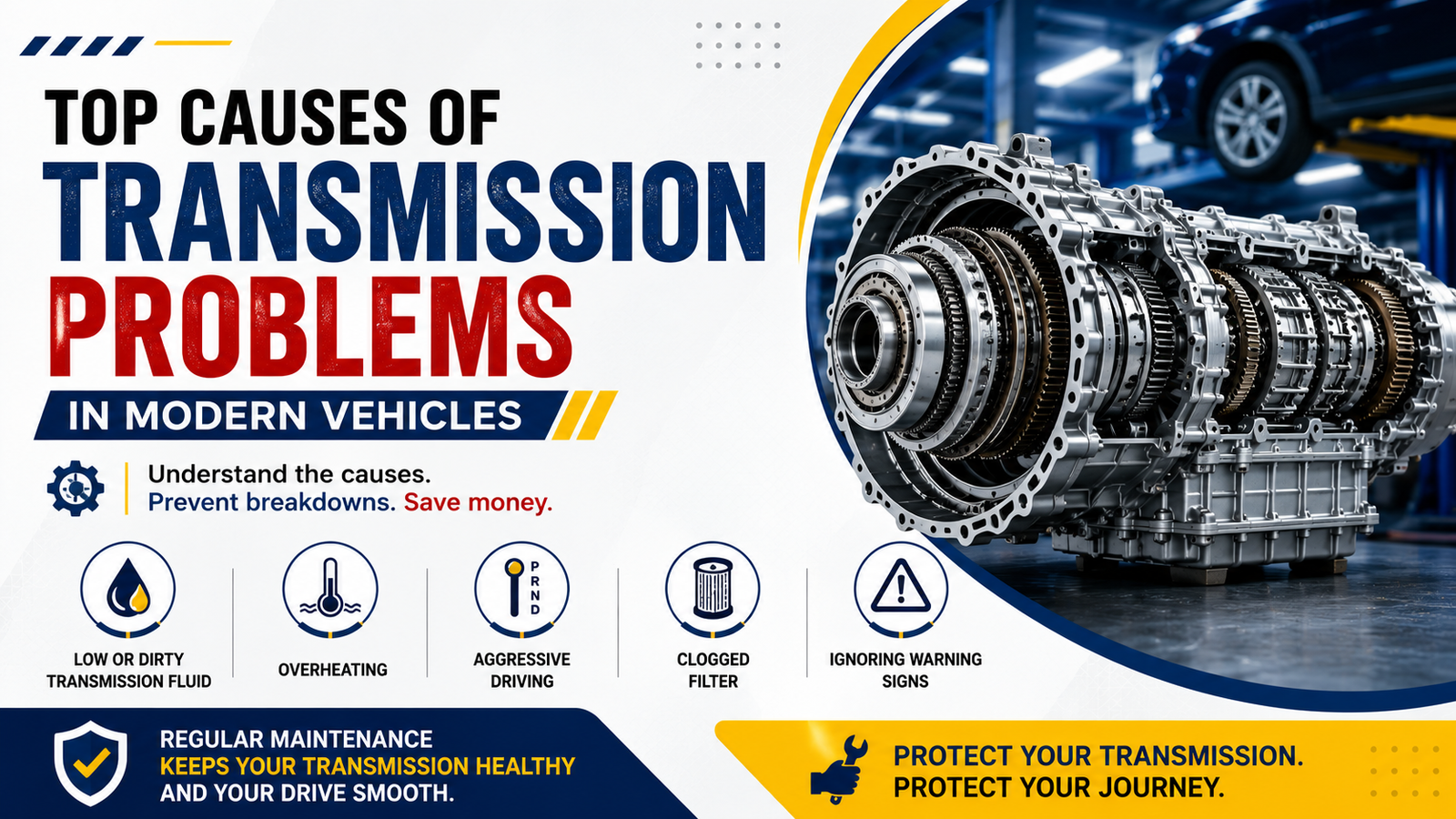
Your transmission does more work than almost any other part of your car, and you only notice it when something goes wrong.
Transmission repair ranks as the second most expensive category of vehicle repair, right behind engine work. According to AAA’s 2025 Vehicle Ownership Cost Survey, the average US household spends around $1,200 a year on vehicle repairs. A transmission problem can take a serious chunk of that budget in one visit.
The good news is that most transmission failures do not happen overnight. They build up slowly through a handful of common causes. Once you know what those causes are, you can catch problems early and avoid the worst repair bills.
Low or Degraded Transmission Fluid
This is the single biggest cause of transmission problems across both automatic and CVT transmissions.
Transmission fluid does three jobs at once. It lubricates moving parts, transfers hydraulic pressure that controls gear shifts, and carries heat away from internal components. When fluid runs low or breaks down, all three of those jobs suffer at the same time.
Low fluid levels cause overheating fast. Without enough fluid to absorb and carry away heat, internal components run hotter than they should. That heat breaks down the fluid further, which makes the problem worse in a cycle that speeds up over time.
A degraded fluid causes slipping. Old fluid loses its ability to maintain the hydraulic pressure that holds gears engaged. The transmission slips between gears, and you feel the engine rev without the car accelerating the way it should.
Around 70% of CVT failures trace back to overheating and fluid degradation specifically. Most manufacturers recommend a CVT fluid change somewhere between 30,000 and 60,000 miles, though this varies by brand. Honda generally suggests 60,000 miles under normal driving. Subaru recommends 30,000 miles for vehicles used for towing or in harsh conditions. Vehicles that stick to a 30,000 to 60,000 mile interval report 40% fewer transmission-related issues compared to those that skip it.
A fluid change typically costs around $200. Skipping it and letting the problem progress can lead to a rebuild costing $3,000 to $5,000. That math makes regular fluid service one of the cheapest forms of insurance your car offers.
CVT-Specific Wear in Belts and Pulleys
Continuously variable transmissions work differently from traditional automatics, and they come with their own wear pattern.
Instead of fixed gears, a CVT uses a belt or chain running between two pulleys that change size to adjust the gear ratio continuously. This system runs under constant tension and depends heavily on proper fluid lubrication to prevent belt slippage and pulley wear.
The Nissan Altima offers a clear real-world example. CVT failure rates in 2013 to 2018 model year Altimas reached 31% by 100,000 miles. That is a significant portion of vehicles experiencing major CVT issues well before the engine itself shows comparable wear. Complete CVT replacement on these models runs $3,800 to $5,500, depending on whether you go to a dealership or an independent shop.
Common early warning signs for CVT-specific problems include shuddering during acceleration, especially in the 20 to 40 mph range, along with whining or grinding noises and delayed engagement when shifting into drive. Catching these signs early and addressing fluid quality often prevents the belt and pulley wear from progressing to full failure.
Overheating From Towing and Heavy Loads
Transmissions generate heat under normal operation, but towing, hauling heavy loads, or driving in stop-and-go traffic in hot weather pushes that heat generation much higher.
When the transmission runs hotter than its cooling system can handle, fluid breaks down faster than it would under normal conditions. That accelerated breakdown shortens the effective life of a fluid change and increases wear on every component the fluid is supposed to protect.
Vehicles regularly used for towing benefit significantly from an aftermarket transmission cooler, which typically costs $400 to $600 installed. This single addition extends fluid life and reduces the cumulative heat stress that drives many of the other problems on this list.
If your vehicle is used for towing or frequent heavy hauling, shortening your fluid change interval toward the lower end of the manufacturer’s range is worth considering. The cost of more frequent fluid changes is small compared to the cost of a transmission that overheats repeatedly over its life.
Why Early Diagnosis Matters So Much
Across every cause on this list, one pattern repeats. Catching the issue early keeps the repair affordable. Letting it progress turns a moderate bill into a major one.
Industry data shows that early intervention, things like a fluid flush, solenoid replacement, or sensor repair in the $300 to $850 range, prevents roughly 80% of cases from progressing to a $2,500 to $8,000 rebuild or replacement. Warning signs caught within the first 500 miles of appearing save the most money and the most stress.
When a rebuild quote climbs past $3,500, a full remanufactured replacement transmission, typically $4,500 to $6,500, often makes more financial sense than continuing to repair an aging unit piece by piece. A remanufactured transmission is fully disassembled, cleaned, inspected, rebuilt with new wear components, and tested before it goes into your car. That gives you a known quality baseline and a warranty, usually one to three years from the supplier.
Labor rates for transmission work vary by region. Independent shops typically run $95 to $140 per hour, while dealerships often run $130 to $210 per hour for the same work. That difference adds up quickly on jobs that take several hours of labor.
What This Means for Your Vehicle
The transmission is built to last the life of your car when it gets the maintenance it needs. Most of the causes covered here come down to one of two things. Fluid that was not changed on schedule, or warning signs that were ignored for too long.
Pay attention to how your car shifts every day. Any change from what feels normal, whether that is a hesitation, a flare, a noise, or a smell, is worth a look before it becomes something bigger.
Claymont Auto diagnoses transmission issues with the right tools and explains exactly what we find before any work begins. Visit claymontauto.com or stop by to have your transmission checked by our team.
Frequently Asked Questions
What Are the First Signs of Transmission Problems?
The earliest signs usually include slipping gears, where the engine revs but the car does not accelerate as expected. Delayed engagement when shifting into drive or reverse is another common early sign. You might also notice rough or jerky shifts, a shudder during light acceleration, or a burning smell coming from under the car. A check engine light with a P0700 series code often appears alongside these symptoms.
Can Low Transmission Fluid Damage Your Car?
Yes, and it is one of the most common causes of serious transmission damage. Low fluid levels reduce the transmission’s ability to maintain hydraulic pressure, which causes slipping and rough shifts. Low fluid also reduces the system’s ability to manage heat, which leads to overheating. Overheating breaks down the remaining fluid faster, creating a cycle that accelerates wear on internal components. If you notice a reddish-brown puddle under your car, that is a fluid leak and should be checked right away. Continuing to drive on low fluid can turn a $200 fluid service into a $3,000 to $5,000 rebuild.
How Much Does Transmission Repair Cost in 2026?
Costs vary widely depending on what is wrong. Early-stage issues like a fluid flush, solenoid replacement, or sensor repair typically run $300 to $850. A full rebuild generally falls in the $2,500 to $8,000 range, depending on the vehicle and transmission type. A remanufactured replacement transmission usually costs $4,500 to $6,500 installed. Specific to CVT vehicles, a complete CVT replacement can run $3,800 to $5,500 at independent shops and higher at dealerships. Labor rates also affect the total, running roughly $95 to $140 per hour at independent shops and $130 to $210 per hour at dealerships. Getting a diagnosis early almost always keeps you toward the lower end of these ranges.
Conclusion
Transmission problems rarely come out of nowhere. They build slowly through fluid that was not changed, electrical components that wore down gradually, or heat stress that built up over thousands of miles.
Knowing the common causes gives you a real advantage. Watch your fluid change intervals, pay attention to how your car shifts day to day, and get unusual symptoms checked right away rather than waiting to see if they get worse.
Claymont Auto provides honest transmission diagnosis and repair, with clear explanations of what we find and what your options are. Visit claymontauto.com to schedule a check before a small issue becomes a major one.