That little amber light on your dashboard is one of the most misunderstood things in car ownership, and ignoring it is getting more expensive every year.
The 2026 CarMD Vehicle Health Index just released data showing the average cost to fix a check engine light issue climbed to a record $554 in 2025. That is a 33% jump from the previous year’s $415. Labor costs alone rose 51% as vehicles became more complex and repairs took longer. Parts costs climbed 23% on top of that.
The drivers who came out ahead were the ones who caught problems early. The ones who waited paid significantly more.
This guide covers everything you need to know about check engine light diagnosis in plain language. No mechanic jargon, no unnecessary confusion.
What the Check Engine Light Actually Means
Your car’s computer monitors dozens of systems at once. Engine performance, fuel delivery, emissions, ignition timing, and more. When any of those systems falls outside the normal operating range, the computer stores a fault code and turns on the check engine light.
That light is officially called the Malfunction Indicator Lamp. It does not mean your engine is about to explode. It also does not mean you can safely ignore it. It means something in your vehicle’s system needs attention, and the computer wants you to know.
The light can come on for something as minor as a loose gas cap or as serious as a failing catalytic converter. The only way to know which one you are dealing with is a proper diagnosis using an OBD2 scanner.
Steady Light vs. Flashing Light
Not all check engine lights carry the same urgency.
A steady light means the computer has stored a fault code and wants you to get it checked. You can usually drive the car to a repair shop without causing immediate damage. Still, do not let it sit for weeks. Small problems become expensive ones quickly.
A flashing check engine light is a different situation entirely. A flashing light typically means your engine is misfiring actively right now. Misfires send unburned fuel into the exhaust system, which can destroy a catalytic converter in a short time. A catalytic converter replacement runs anywhere from $800 to over $2,000, depending on the vehicle. Pull over safely and call a car repair shop. Driving hard with a flashing check engine light is a fast way to turn a $150 repair into a $1,500 one.
How OBD2 Scanners Work
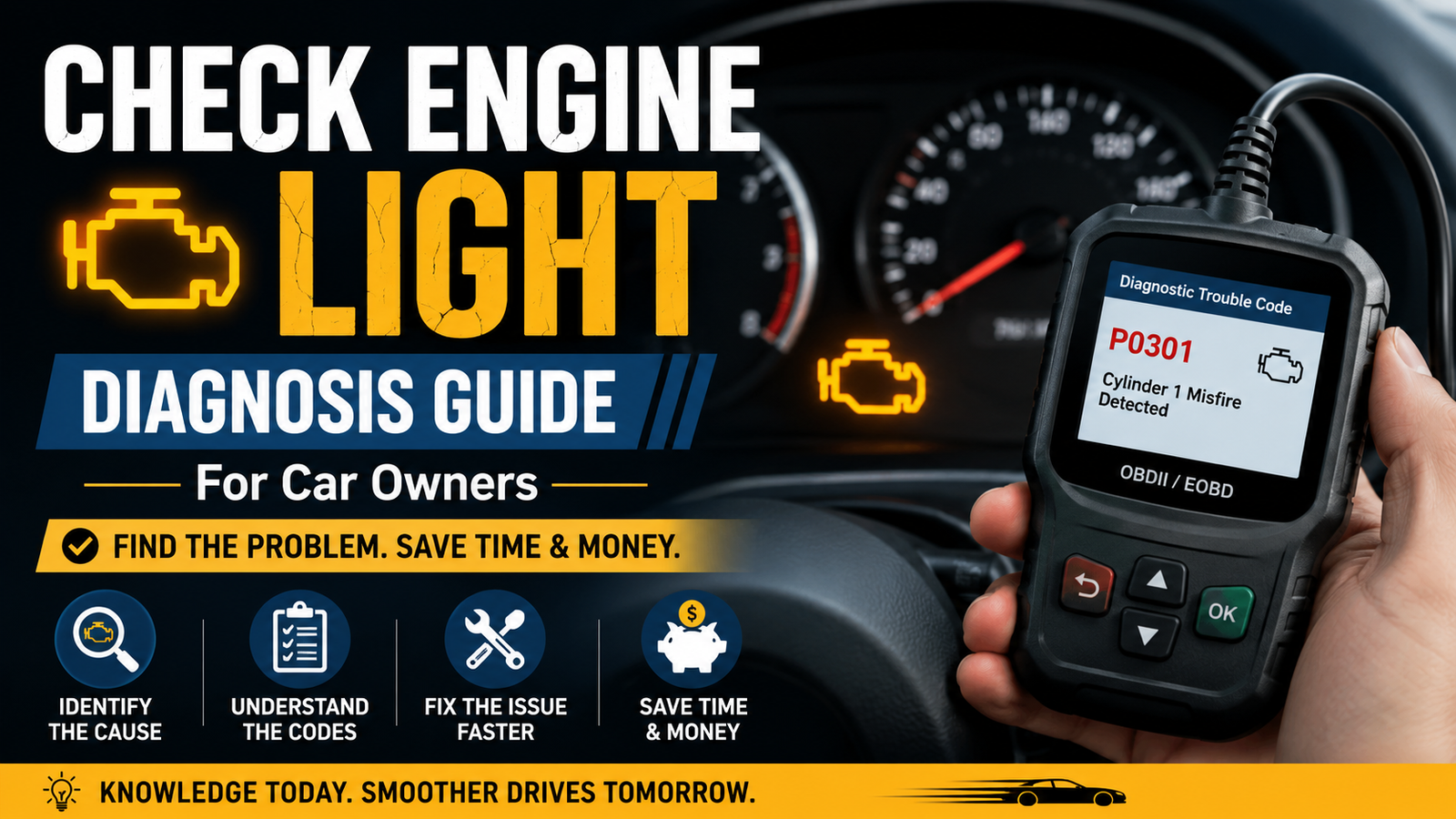
Every vehicle sold in the US after 1996 has an OBD2 port. It usually sits under the dashboard on the driver’s side. When a mechanic plugs a scanner into that port, the scanner reads diagnostic trouble codes stored in the car’s computer.
Each code uses a letter and four numbers. P codes cover the powertrain, which includes the engine and transmission. B codes cover body systems. C codes cover the chassis. U codes cover the network between modules.
Common codes most car owners eventually encounter include P0420 for catalytic converter efficiency issues, P0300 for random engine misfires, and P0171 for the engine running too lean on fuel. Each code points toward a system, not a single definitive answer. A P0420 code, for example, could mean a failing catalytic converter, a bad oxygen sensor, or an exhaust leak. A good technician reads the code as the starting point, not the conclusion.
Basic OBD2 scanners cost between $30 and $100 and can read codes at home. Mid-range scanners in the $100 to $300 range show live data from oxygen sensors, fuel trims, and misfires in real time. That live data is what separates a thorough diagnosis from a guess. A professional car repair shop uses advanced diagnostic equipment that reads far more than basic codes, including freeze frame data showing exactly what the engine was doing the moment the fault triggered.
Most Common Reasons Your Check Engine Light Comes On
Catalytic converter issues top the list year after year. CarMD’s 2026 data covering over 39 million vehicles confirms this again. The catalytic converter handles your car’s emissions by converting harmful exhaust gases before they leave the tailpipe. When it fails, you get a P0420 code and a check engine light. Replacement costs range widely but typically run between $900 and $2,500, depending on make and model.
Oxygen sensor failure comes in second consistently. Your car uses O2 sensors before and after the catalytic converter to fine-tune the fuel mix and monitor emissions. A failing sensor throws off that fuel calculation. CarMD notes that ignoring a faulty oxygen sensor can hurt your fuel economy by as much as 40% without you even noticing a driving change.
Ignition coils and spark plugs cause more check engine lights than most people realize. Worn spark plugs create misfires, which store P0300 or cylinder-specific P0301 through P0306 codes. The fix is usually affordable. A set of spark plugs for a four-cylinder engine typically runs $40 to $100 in parts. Left unresolved, misfires damage the catalytic converter and turn an affordable repair into a much bigger bill.
A loose or damaged gas cap is the simplest cause of all. The fuel system needs to stay sealed. A loose cap lets vapors escape and triggers an evaporative emission code. Tightening or replacing the cap costs almost nothing and clears the light on its own after a few drive cycles.
Mass airflow sensor failure affects how the engine measures incoming air. A dirty or failing sensor causes rough idle, hesitation during acceleration, and poor fuel economy alongside the check engine light. Cleaning the sensor sometimes resolves it. Replacement runs around $150 to $350.
What Happens During a Professional Check Engine Light Diagnosis
A good car repair shop does more than just read the code off your OBD2 system.
The technician pulls all stored codes, including pending codes that the computer has noticed but not yet officially flagged. They review freeze frame data showing engine load, coolant temperature, RPM, and fuel trim at the exact moment the fault triggered. That context matters. A P0420 code triggered at highway speed under heavy load tells a different story than the same code triggered at idle after a cold start.
After pulling codes, a thorough technician checks live sensor data with the engine running. Watching oxygen sensor voltages in real time, for example, reveals whether the sensor itself is faulty or whether the catalytic converter is genuinely failing. Replacing a $200 oxygen sensor is very different from replacing a $1,500 catalytic converter. Getting the diagnosis right before ordering parts saves real money.
Most shops charge a diagnostic fee between $75 and $150 to cover this process. Many apply that fee toward the repair cost if you proceed with them. Always ask upfront.
When You Can Drive and When You Should Not
A steady check engine light with no other symptoms, no rough running, no loss of power, no unusual smells, usually means you can drive carefully to a shop within the next day or two.
Add any of the following, and you should not wait. Flashing check engine light. Rough or shaking idle. Strong smell of burning or rotten eggs. Smoke from the engine bay. Significant loss of power. The temperature gauge is running hot. Any of these alongside a check engine light means something more serious is happening, and continued driving risks real damage.
If you feel uncertain at all, call a car repair shop before driving further. A short phone call is free. A blown engine is not.
Frequently Asked Questions
Can You Drive Safely With the Check Engine Light On?
It depends on the light and how the car feels. A steady check engine light with normal driving behavior means you can usually get to a shop within a day or two without causing additional damage. A flashing check engine light means stop driving as soon as it is safe and call a repair shop immediately. An active misfire can destroy a catalytic converter quickly. If the check engine light comes on alongside any other warning light, rough running, loss of power, or unusual smell, treat it as urgent and do not keep driving until you know what is happening.
What Is the Most Common Reason for a Check Engine Light?
Catalytic converter issues top the list based on CarMD’s annual Vehicle Health Index, which covers data from tens of millions of US vehicles. Oxygen sensor failure ranks second. Ignition coils and spark plugs come in third. A loose gas cap, though minor, also triggers the light frequently and is the easiest fix of all. Most check engine lights trace back to one of these five causes, but a proper OBD2 diagnosis is the only way to confirm which one you are actually dealing with.
How Much Does a Check Engine Light Diagnosis Cost in 2026?
Professional diagnostic fees typically run between $75 and $150 at most car repair shops. Many shops credit that fee toward the repair if you use them for the work. The average cost to fix whatever the check engine light reveals climbed to a record $554 in 2025, according to CarMD’s 2026 Vehicle Health Index, up 33% from the prior year. Simple fixes like a gas cap replacement or spark plug swap cost far less. Complex repairs like catalytic converter replacement can run well over $1,000. Getting an accurate diagnosis first is the best way to understand the actual cost before committing to any repair.
Conclusion
The check engine light is not your enemy. It is your car trying to tell you something before a small problem grows into a big one.
In 2026, with repair costs at record highs and vehicles aging longer than ever, acting on that light early is one of the most practical things a car owner can do. Read the code, understand what it points to, and get a proper diagnosis from a shop that explains what they find and why.
Claymont Auto provides honest check engine light diagnosis and repair for drivers who want straight answers and fair pricing. Visit claymontauto.com to schedule a diagnostic appointment and find out exactly what your vehicle needs.